Halal & Kosher Cheese: What Certifications Mean & How They’re Made
Halal and Kosher cheese certifications verify strict religious dietary compliance. For Kosher cheese, production requires rabbinical supervision and suitable rennet sources, while Halal certification guarantees no pork-derived ingredients or alcohol in the cheesemaking process. Both systems emphasize humane animal treatment and equipment purity standards, though they differ in specific requirements.
You'll need to check for official certification symbols on packaging to confirm authenticity. Discover the fascinating details behind these ancient food traditions.
Understanding Halal and Kosher Dietary Laws
Why do so many people follow religious dietary restrictions in our modern world? These ancient traditions provide cultural identity, spiritual connection, and ethical frameworks for food consumption.
Jewish dietary laws (kashrut) require Kosher cheese to be made with kosher animal rennet or plant-based alternatives, under rabbinical supervision.
Similarly, Islamic dietary laws dictate that Halal cheese must avoid pork-derived ingredients and alcohol in the cheese making process. Both systems emphasize humane treatment of animals and purity of dairy products.
The certification process for Halal certified cheese involves inspection by qualified Islamic authorities, while Kosher certification requires oversight by trained rabbinical inspectors. Many people also choose vegetarian cheese options which align with these religious requirements while offering additional health benefits. Despite their differences, both systems share common values: respect for religious traditions, cleanliness in food production, and accountability through third-party verification.
The Cheese-Making Process: From Milk to Market
While we often enjoy cheese as a finished product, its journey from milk to market involves several critical stages that determine whether it's Halal or Kosher compliant.
The process begins with dairy milk being curdled through the addition of rennet or acidic substances. This enzyme complex, traditionally extracted from mammal stomachs, coagulates milk proteins.
Once formed, the curds are cut, cooked, and separated from the liquid whey.
Next, you'll find these curds being salted, pressed into molds, and subjected to aging, which develops the cheese's distinctive texture and flavor profile. During this time, the rind develops and the cheese matures.
The final stage involves packaging the finished product for distribution to retailers and ultimately, your table.
During this process, lactic acid bacteria play a crucial role in fermenting milk sugars and creating the distinctive flavors and textures of different cheese varieties.
Rennet Sources and Religious Requirements
Because rennet plays a pivotal role in cheese production, its source greatly impacts whether cheese qualifies as Halal or Kosher. For Halal compliance, animal rennet presents challenges due to uncertainty about slaughter methods. Instead, you'll find plant-based rennet derived from thistles and nettles as acceptable alternatives that maintain religious requirements.
Microbial enzymes and genetically-modified sources also provide Halal-friendly options for cheesemakers seeking certification. When selecting Halal cheese, don't overlook the rind, which may contain non-compliant ingredients like lard or oils.
Halal certification verifies that all components—including the often-overlooked rind—meet strict religious standards. Similarly, kosher certification validates that cheese production adheres to Jewish dietary laws, with particular attention to enzyme sources and processing methods.
Cheese Rind Considerations for Religious Certification
Few cheese enthusiasts realize that the rind—the outer layer of cheese—can undermine religious certification status, even when the cheese itself meets all requirements. For Halal-certified cheese, manufacturers must guarantee the rind contains no animal-derived ingredients like lard or oils that violate Islamic dietary law.
When you're seeking Kosher and Halal compliant options, don't rely solely on ingredient lists, as manufacturers may change rennet types without notice. Vegetarian cheese might seem like a safe alternative, but you'll still need to verify how the rind is created to confirm it meets religious standards.
The best assurance comes from proper Halal certification, which confirms that both the cheese and its rind fully comply with dietary requirements—giving you confidence in your selection without compromising your religious practices.
Dairy Processing Equipment Standards for Certification
Since equipment cleanliness directly impacts religious certification, Kosher and Halal standards diverge considerably in their processing requirements. Kosher certification demands kashering (purification) of equipment based on its production history, creating a more complex process than Halal standards require.
When pursuing Kosher certification, you'll need to navigate varying acceptability among different Jewish sects, each interpreting Jewish dietary law differently. In contrast, Halal certification follows more uniform standards, requiring only cleaning (dibagh) if equipment previously processed haram products.
Don't assume Kosher certification guarantees Halal compliance. The requirements differ fundamentally, and you should seek independent Halal certification for products intended for Muslim consumers. Manufacturers must understand that while both certifications address equipment standards, they represent distinct religious requirements with different implementation processes.
Certification Symbols: What to Look for on Packaging
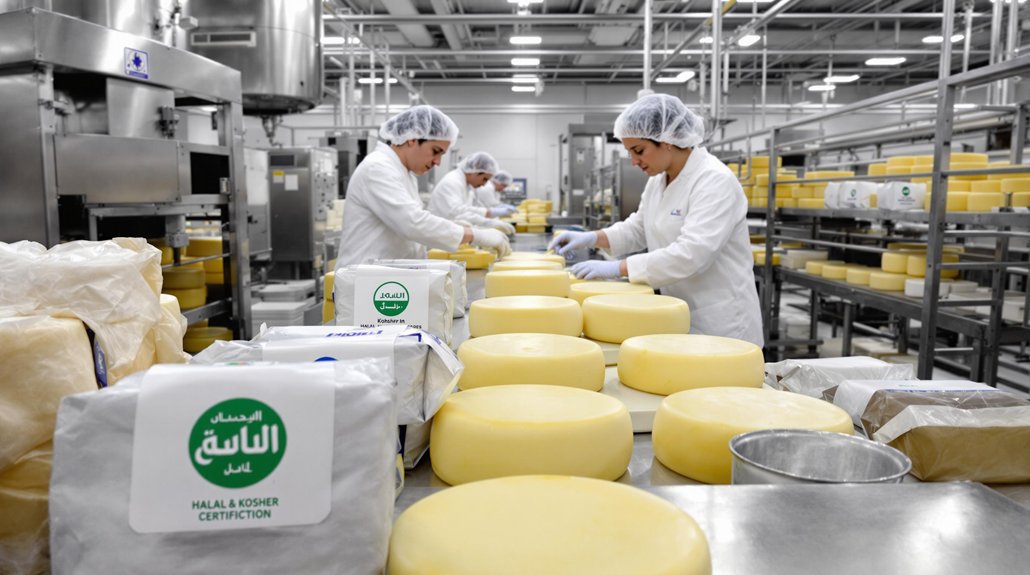
While equipment standards guarantee proper processing, consumers ultimately rely on packaging symbols to verify religious compliance. When shopping for Halal-Certified Product options, look for official marks from organizations like Halal Certification Services or Halal Food Council USA. These symbols—typically featuring "Halal" or "Zabihah Halal"—confirm adherence to Islamic dietary laws.
For Kosher compliance, watch for the "OU" symbol or "K" designation. The presence of both Halal and Kosher certification indicates the cheese has met dual religious standards.
Organizations specializing in Certification in Food Safety often provide these validations, ensuring the product meets all religious requirements. Vegetarian certification can further indicate the absence of animal-derived rennet. By identifying these symbols, you'll confidently select cheese that aligns with your religious dietary practices.
Beyond Cheese: Halal and Kosher Requirements for Other Dairy Products
Many dairy products beyond cheese require careful religious certification due to their complex ingredient profiles. Yogurt may contain animal-derived gelatin, making Halal certification essential to guarantee it meets Islamic dietary laws. While whey protein is inherently Halal, its manufacturing process using rennet requires validation for Muslim consumers.
Dairy desserts like ice cream and cakes typically contain numerous ingredients, complicating the determination of their religious compliance. Halal certification eliminates the need for consumers to analyze each component individually, ensuring the entire food product adheres to Islamic requirements.
Organizations like the American Halal Foundation bring decades of expertise to the certification process, offering globally recognized verification for dairy products. Their thorough inspection provides peace of mind to consumers seeking compliant food options without the burden of extensive ingredient research.
The Global Market for Certified Cheese Products
As religious dietary preferences continue to influence consumer choices, the certified cheese market has exploded into a powerhouse industry projected to exceed $100 billion by 2027. Halal-certified cheese dominates this landscape, with Asia-Pacific consumers leading global demand for these religiously compliant food options.
Meanwhile, Kosher cheese maintains steady growth in North America and Europe, where Jewish communities strictly adhere to traditional dietary laws. You'll find specialty cheese producers increasingly pursuing both certifications to access this expanding consumer base.
The rise of online sales and e-commerce has transformed the global certified cheese market, making these products more accessible than ever before. Whether you're seeking Halal or Kosher options, you can now order authentic, certified cheeses from specialty producers worldwide with just a few clicks.
Navigating Certification Processes for Cheese Manufacturers
Securing religious certification for cheese production involves complex procedures that manufacturers must carefully navigate to reach observant consumers. For halal certification, you'll need thorough auditing of your entire production chain, ensuring adherence to Islamic dietary laws at every stage.
Your cheese must contain only halal-approved enzymes, with special attention to the slaughter process for animal-derived ingredients. Expect ongoing monitoring through semi-annual reports and surprise inspections to maintain your certification status.
When pursuing kosher certification, be aware that standards may vary between Jewish sects, affecting your ingredient sourcing and production methods. This contrasts with halal's more uniform requirements.
Both certifications require rigorous documentation and transparent manufacturing practices, but the investment opens valuable market opportunities with religiously observant consumers worldwide.