What Are Some Historical Facts About Mac and Cheese?
Mac and cheese's history dates back further than you'd think - all the way to ancient Rome in 160 BCE, where they created a layered pasta and cheese dish called Placenta. The comfort food evolved through medieval Europe before Thomas Jefferson and his enslaved chef James Hemings brought French-style versions to America in the late 1700s. Kraft later revolutionized the dish during the Great Depression with their 19-cent boxed dinner, but there's much more to this cheesy story.
Ancient Roman Roots of Pasta and Cheese
While many consider mac and cheese a modern comfort food, its origins trace back to ancient Rome in 160 BCE. The Romans created a dish called Placenta, which layered cheese between sheets of whole grain dough, establishing the first documented recipe combining pasta and cheese.
You'll find that this comforting combination became deeply rooted in Roman culinary traditions, eventually spreading throughout Western Europe. By the 13th century, you can trace the evolution of pasta and cheese dishes in cookbooks like Liber de coquina and Libro della cocina, which featured early versions of what we'd recognize as lasagna. The term "macaroni" first appeared in 1279 in Italy, documented in a military officer's inventory.
These early iterations laid the foundation for the cheese sauce and pasta combinations we enjoy today. Much like the monastic cheese-making traditions of medieval Europe, these early pasta and cheese dishes played a significant role in culinary development.
Medieval European Evolution
During the Middle Ages, you'd find macaroni and cheese altering from its Roman origins into more distinctive European variations. The medieval European evolution of this dish first appeared in cookbooks as Lasanis and Lasagne during the 13th century. You'll uncover that by 1390, the English cookbook Forme of Cury introduced Makerouns, an early version of what we now know as macaroni and cheese.
The dish continued to morph through the 15th century when Maestro Martino created his Roman macaroni recipe, featuring a rich combination of butter and cheese. By the time it reached France in the mid-18th century, you'd notice a significant change in preparation methods, as French cooks developed a creamier style that would influence modern versions of this beloved comfort food. Medieval monasteries played a crucial role in developing unique cheese recipes that would later influence pasta dishes throughout Europe.
The French Connection and Thomas Jefferson
After serving as the American ambassador to France in the late 18th century, Thomas Jefferson brought macaroni and cheese recipes back to America, forever changing the nation's culinary terrain. You might be surprised to learn that Jefferson's enslaved chef, James Hemings, played a vital role in this food history milestone. Trained in French cuisine, Hemings helped introduce macaroni and cheese to American tables, even serving it as "macaroni pie" at a prestigious 1802 state dinner.
Jefferson's passion for this dish was evident in his 1807 purchase of significant amounts of parmesan cheese and macaroni. Behind this culinary innovation lies a complex story - Hemings negotiated his freedom in 1793 by agreeing to train another enslaved person as his replacement, highlighting the often overlooked contributions of enslaved chefs to American cuisine. While modern recipes often use cow's milk cheese, traditional cheese-making relied on sheep or goat milk for optimal texture and flavor.
James Hemings' Culinary Legacy
Behind the timeless comfort of America's mac and cheese lies the exceptional story of James Hemings, whose culinary prowess helped shape the nation's food culture. As Thomas Jefferson's enslaved chef de cuisine, Hemings mastered French cooking techniques during his training in Paris, bringing macaroni and cheese recipes back to the United States.
You might not know that Hemings negotiated his freedom in 1793, but only after agreeing to train his replacement for three years. While he didn't leave written records of his recipes, his French-style approach to the dish revolutionized how Americans prepared this comfort food. Though his life ended tragically by suicide after gaining freedom, Hemings' culinary legacy endures. His sophisticated take on macaroni and cheese helped refine a simple recipe into what would become a beloved American staple.
Early American Cookbook Recipes
While mac and cheese recipes traveled across the Atlantic through various channels, America's first published versions appeared in influential cookbooks of the late 18th and early 19th centuries. The earliest recorded recipes, dating from 1784, detailed a simple process of boiling macaroni and combining it with cream, butter, and cheese.
Though Jefferson and Hemings helped popularize this food in America, it was Mary Randolph who published one of the country's first formal recipes for baked macaroni and cheese in her 1824 cookbook "The Virginia House-Wife." This followed Raffald's recipe from 1769, which established the modern foundation for the dish. By the 1880s, mac and cheese recipes had become widespread, appearing in cookbooks across the United States, cementing its place in American cuisine.
The Birth of Kraft's Boxed Sensation
During the depths of the Great Depression in 1937, Kraft revolutionized American dining with its introduction of boxed macaroni and cheese. You could feed a family of four for just 19 cents with one box of this innovative pasta dish, making it an instant hit during tough economic times. The combination of macaroni and processed cheese quickly became known as Kraft Dinner, selling an impressive 8 million boxes in its first year alone.
The product's success continued through World War II, when food rationing made it an essential household item. Just add boiling water and cook - it was that simple! Here's why it became a sensation:
- Affordable price point during economic hardship
- Long shelf life and easy storage
- Simple preparation that anyone could conquer
World War II Impact and Popularity
As World War II gripped the nation, Kraft's macaroni and cheese became more than just an affordable meal - it metamorphosed into a symbol of American resourcefulness.
During this challenging period, you'd find the iconic blue box in countless American households as food rationing made it difficult to obtain fresh ingredients. The shelf-stable nature of Kraft Macaroni and Cheese, combined with its convenient preparation and budget-friendly price, made it an ideal solution for families stretching their resources.
You'll be interested to know that it wasn't just civilians who welcomed this comforting dish - soldiers and their loved ones found solace in this simple pleasure during wartime hardships. The product's popularity during World War II helped establish it as a quintessential American food, securing its place in pantries long after the war ended.
Regional American Variations
The evolution of mac and cheese didn't stop with wartime convenience foods. As it spread across America, you'll find distinct regional variations that reflect local tastes and cultural influences. From the Great Depression through modern times, each area has developed its own spin on this comfort food classic.
In the American South, you'll uncover Macaroni Pie, a rich casserole-style dish that's layered like lasagna with eggs and evaporated milk. The Northeast pairs its sharp white cheddar version with classic comfort foods, while West Coast chefs augment Mac N Cheese with luxurious additions.
- Midwest: Topped with crushed cornflakes or crackers
- South: Mixed with macaroni, eggs, and salt and pepper
- West Coast: Enhanced with parmesan, truffle oil, or seafood
Global Mac and Cheese Traditions
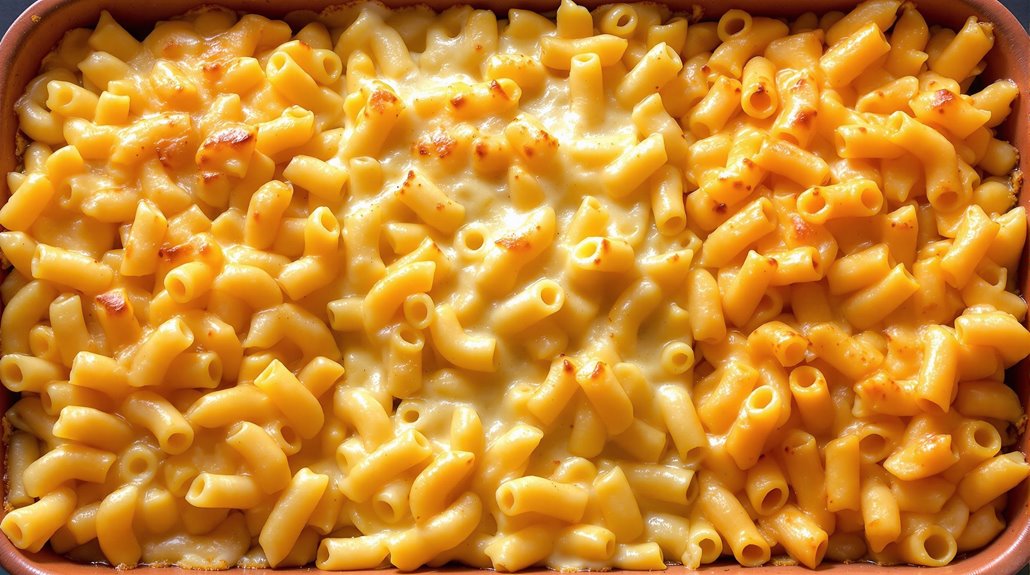
Most people think mac and cheese is purely American, but this beloved comfort food has rich traditions spanning multiple continents. You'll find its earliest roots in 13th-century Italian cookbooks, where pasta and cheese dishes laid the foundation for what we enjoy today.
The French brought their own flair to macaroni and cheese in the 1700s, when French chefs created a creamier version using butter and cheese. This style quickly spread to England, where it appeared in English cookbooks and became a fashionable dish among the upper class. Today, you'll uncover unique interpretations worldwide, with countries adapting the recipe for macaroni to suit local tastes. In Canada, the passion for this dish runs so deep that Canadians consume a quarter of all packaged mac and cheese sold globally each week.
From Home Kitchen to Restaurant Tables
During the late 19th century, macaroni and cheese made a stunning leap from humble home kitchens to prestigious restaurant tables. You'd find this comforting dish at New York's elite Delmonico's restaurant in the 1870s, where it had become one of their signature contributions. The recipe calls for sophisticated ingredients like Gruyère and Parmesan, elevating it far beyond basic homestyle preparations.
This change brought about three notable changes:
- High-end restaurants began featuring elaborate mac and cheese variations with béchamel sauce
- The 1916 Boston Cooking-School Cook Book included a "company dinner" version
- The dish became popular at both upscale establishments and community gatherings
This evolution shows how a simple comfort food crossed social boundaries, appearing on menus from church suppers to the finest dining rooms in America.