What Was President Ronald Reagan’s Role in Releasing Government Cheese
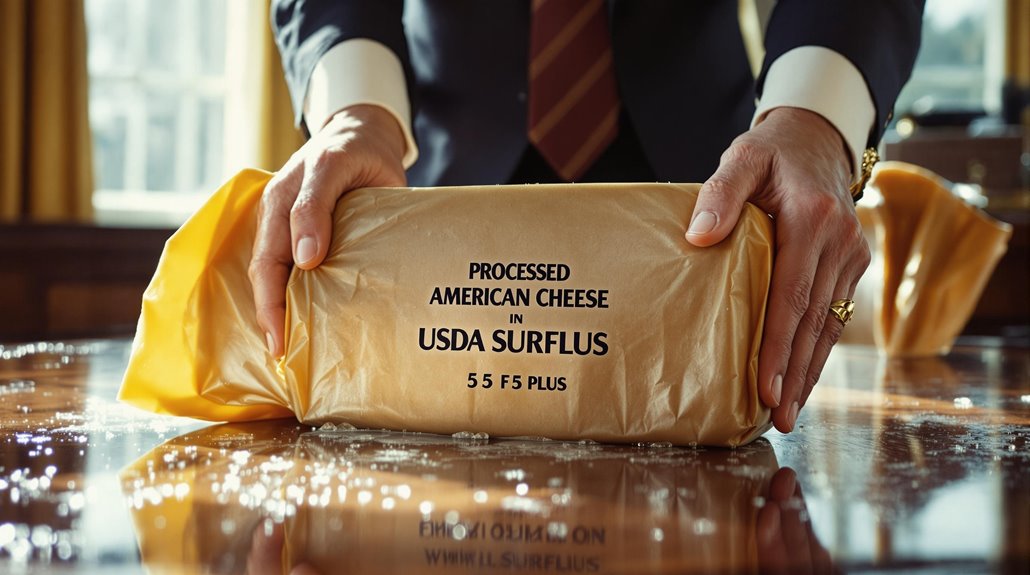
You'll find that President Reagan took decisive action on America's massive cheese surplus in 1981. He authorized the release of 30 million pounds of government-stored cheese to help needy families during a tough recession. His administration's move addressed both the expensive storage costs (over $1 million daily) and widespread food insecurity. This famous "government cheese" program would become one of the most memorable initiatives of his presidency, with implications that stretched far beyond the dairy industry.
The Growing Dairy Crisis of the 1970s
How did America end up with mountains of surplus cheese? It all started in the 1970s when government price supports created an unexpected crisis in the dairy industry. You might not know it, but these agricultural policies guaranteed minimum prices for milk, leading farmers to produce far more than the market needed.
The results were staggering. By 1981, the Commodity Credit Corporation had amassed over 500 million pounds of government cheese, costing taxpayers more than $1 million daily just to store it. During a time of widespread food insecurity, this surplus sat in warehouses, disconnected from communities that desperately needed food assistance. Before Reagan stepped in, this dairy crisis highlighted how well-meaning price supports had backfired, creating an expensive and logistically challenging stockpile that symbolized the unintended consequences of agricultural intervention. Much of this surplus consisted of mild cheddar cheese, which was ideal for melting and could have been used in countless dishes to feed hungry Americans.
Reagan's Farm Bill and Economic Strategy
When President Reagan took office in 1981, his administration faced an unusual challenge: what to do with mountains of surplus cheese that were costing taxpayers a fortune to store.
While Reagan's economic policies, known as Reaganomics, focused on reducing government spending and regulation, his farm bill actually maintained price supports for dairy farmers. This approach, combined with existing subsidies, led to continued overproduction and a massive cheese stockpile that grew to over 1 billion pounds by the late 1980s.
To address this issue, Reagan signed legislation authorizing the distribution of more than 500 million pounds of government cheese through food assistance programs. You'll find it interesting that this initiative served two purposes: reducing storage costs while providing food aid to Americans struggling with unemployment and inflation during the early 1980s.
Much of this surplus cheese was processed using Kraft's pasteurization process, which helped ensure the distributed cheese would maintain a longer shelf life.
The 1981 Cheese Distribution Initiative
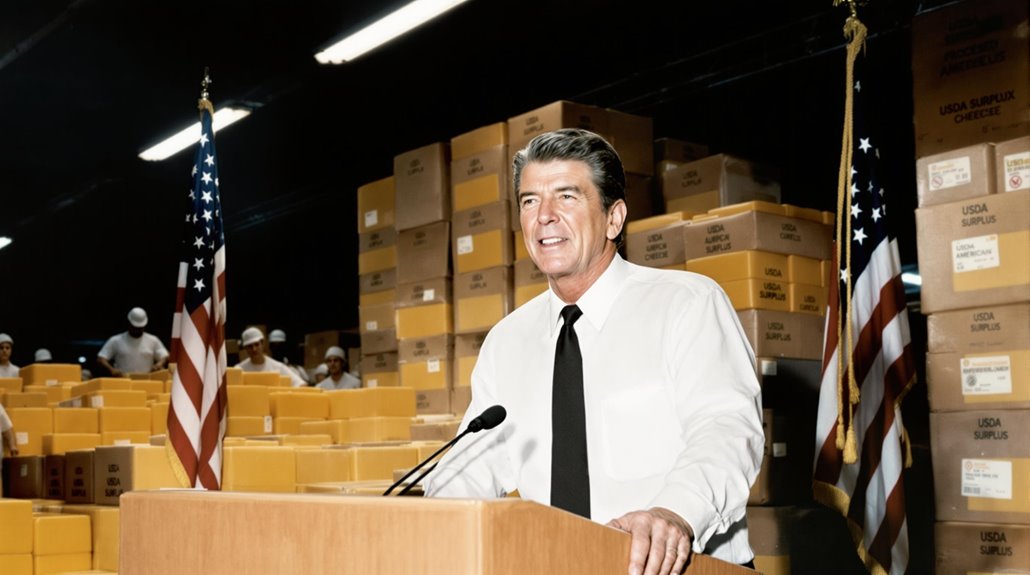
President Reagan's decision to distribute 30 million pounds of surplus cheese marked a pivotal moment in addressing America's dairy crisis. Ronald Reagan authorized this bold move in 1981 when the government's stockpile had reached an overwhelming 560 million pounds of cheese. The mass production techniques that emerged during the industrialization of cheesemaking had contributed significantly to this surplus situation. The program, known as TEFAP, served two purposes: it helped reduce storage costs for the massive surplus while providing food assistance to low-income Americans during the economic downturn.
The government cheese program became instantly recognizable by its distinctive neon-orange blocks, which you'd commonly see distributed through various food assistance initiatives. This ingenious solution highlighted Reagan's practical approach to managing agricultural excess, though it also revealed the underlying issues with policies that had encouraged dairy farmers to overproduce in the first place.
Impact on American Families During the Recession
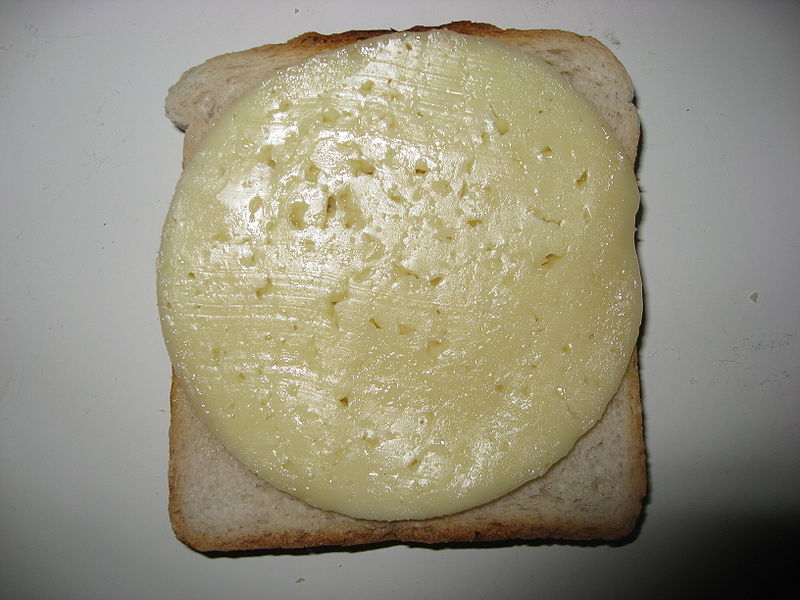
During one of America's toughest economic periods, the government cheese program became a lifeline for struggling families across the nation. If you were POOR, you'd find that these Programs would provide much-needed Assistance through the distribution of Processed American cheese blocks.
The government cheese phenomenon altered the way many Americans viewed dairy products during the recession. As SURPLUS CHEESE GOES to those in need, you'd notice the distinctive orange blocks becoming a symbol of both relief and stigma. The American cheese stockpile, which Reagan authorized for distribution when he signed the initiative, helped feed over 300 million Americans. You would've seen how these distributions, while essential for survival, also highlighted the challenging reality of poverty and dependence on government assistance during the 1980s recession.
Storage and Logistics of Government Cheese
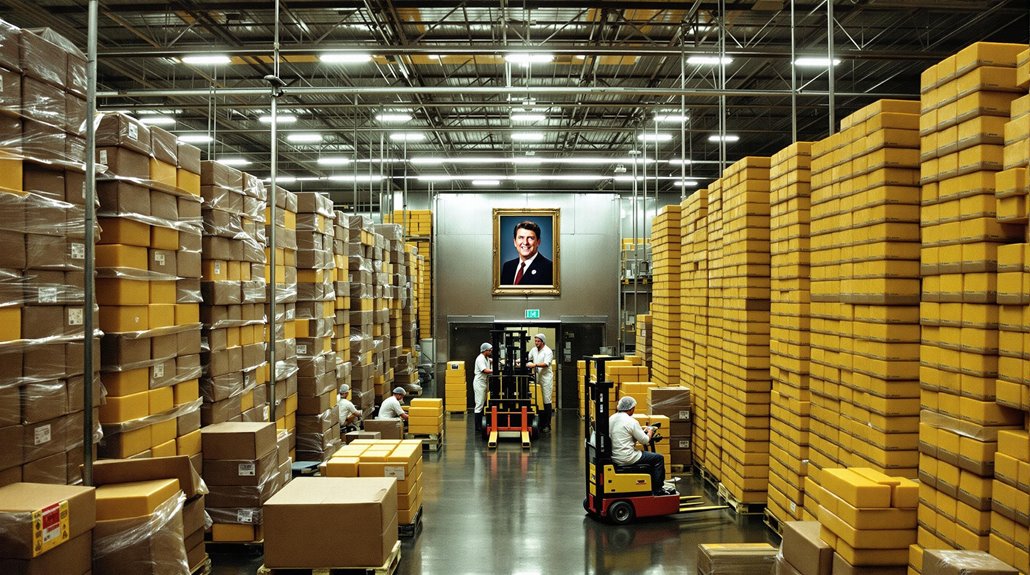
The massive stockpile of government cheese created extraordinary storage challenges for the U.S. administration. The United States Department of Agriculture and Commodity Credit Corporation (CCC) struggled to manage over 1.4 billion pounds of processed cheese in warehouses across America, costing taxpayers more than $1 million daily in storage fees.
The government's attempt to maintain price support levels for the dairy industry resulted in these key logistics obstacles:
- Storage facilities were often situated far from food banks and communities in need
- The sheer volume of surplus cheese could've formed a 30-foot-high monument weighing 55 million pounds
- Refrigerated warehouses required constant maintenance and energy consumption to prevent spoilage
This inefficient system not only strained federal resources but also created distribution challenges for getting government cheese to those who needed it most.
Public Reception and Social Implications
While government cheese provided essential sustenance to millions of Americans, its distribution created lasting social stigma among recipients. You'll find that many who participated in these welfare programs felt shame when collecting their allotted cheese from food pantries, as it clearly marked their socioeconomic status.
Headlines like "CHEESE GOES TO POOR" and "CHEESE WOULD Feed Hungry" reinforced these feelings of marginalization. Beyond the social implications, the program highlighted practical challenges. If you were lactose intolerant or vegan, you'd face limited options, often having to pass the cheese to family members or waste it. The high sodium content raised health concerns, particularly for those dependent on food stamps and government assistance. What started as a farm surplus solution became what some called the "Tyranny and the Comfort" of government cheese distribution.
Changes to Agricultural Policy Under Reagan

As President Reagan took office in 1981, his administration swiftly implemented sweeping changes to America's agricultural policies, particularly in dairy management. The shift marked a departure from Jimmy Carter's approach, as Reagan signed the 1981 Agriculture and Food Act to address the mounting cheese surplus in the dairy market.
Key changes to agricultural policy included:
- The federal government authorized the Commodity Credit Corporation (CCC) to distribute 560 million pounds of stored cheese to low-income Americans
- The US Government revised Milk Prices support systems to better manage dairy production
- The Agriculture Secretary gained new authority to oversee surplus dairy distribution programs
These reforms showcased Reagan's dual approach of supporting the dairy industry while providing food assistance to those in need, fundamentally reshaping how the government managed agricultural surpluses.
Legacy of the Government Cheese Program
Looking back at Reagan's government cheese program reveals a complex legacy of both positive impacts and unintended consequences. When President Ronald released millions of pounds of processed cheese through the Temporary Emergency Food Assistance Program, you could see both benefits and drawbacks emerge. While government cheese became an instrumental lifeline for struggling families and supplemented federal food stamp benefits, it also created market inefficiencies and stigmatized recipients.
The program's massive dairy surpluses strained the federal budget, leading to significant policy changes in the 1990s. Today, the distribution of pounds of surplus cheese through school lunch programs continues to spark debates about food policy and agricultural subsidies. The Emergency Food Assistance Program's lasting impact demonstrates how well-intentioned policies can simultaneously help those in need while disrupting market forces.