Who Invented Macaroni and Cheese?
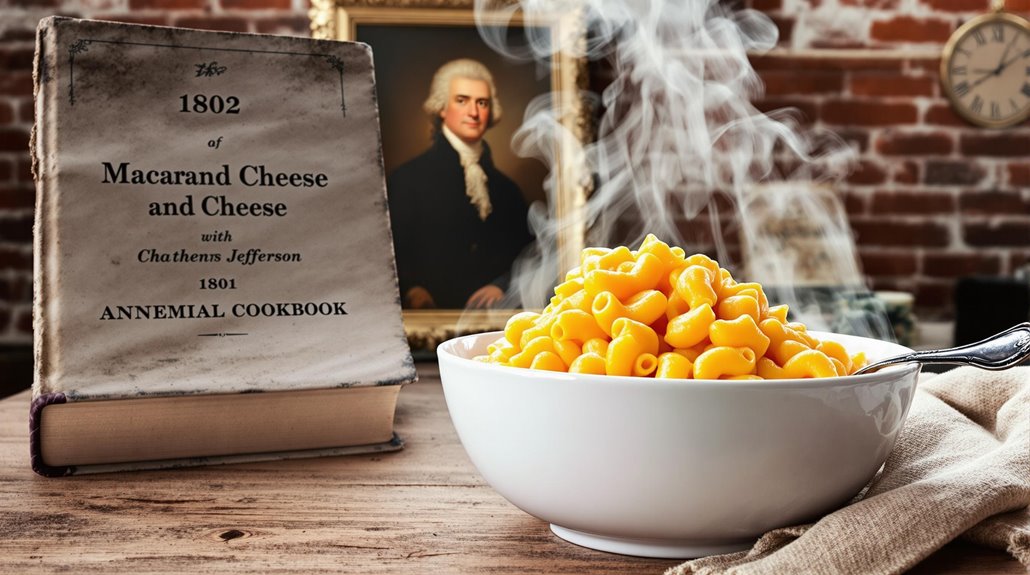
You can't pin macaroni and cheese on a single inventor - its story spans over two millennia, starting with an ancient Roman dish called "Placenta" in 160 BCE. The comfort food evolved through medieval European kitchens, got refined in France, and found its American identity through Thomas Jefferson and his enslaved chef James Hemings. While Kraft popularized the boxed version in 1937, the dish's rich history reveals fascinating connections between cultures, innovation, and social change.
Ancient Roman Origins and Early History
While many consider macaroni and cheese an American comfort food, its origins stretch back to ancient Rome. You'll find the earliest recorded pasta and cheese combination in a dish called "Placenta" from 160 BCE, marking the beginning of this culinary tradition.
Throughout the Middle Ages, you can trace the evolution of pasta and cheese dishes in significant cookbooks. The 13th-century Italian manuscripts "Liber de coquina" and "Libro della cocina" featured layered recipes that would later influence modern versions. The term "macaroni" first appeared in 1279, while variations like "lasanis" and "lasagne" became deeply rooted in medieval cuisine.
By 1390, you'll uncover "makerouns," an early mac and cheese predecessor, documented in the English cookbook "Forme of Cury," demonstrating how this dish had already spread beyond Mediterranean borders. The Roman cheese expertise was crucial to developing these early pasta and cheese combinations, as Romans had mastered various cheese-making techniques and turned it into a fine art.
The Evolution Through Medieval Europe
The spread of macaroni and cheese through medieval Europe altered the simple Roman dish into increasingly sophisticated variations. You'll find early evidence of pasta and cheese combinations in 13th century Italian cookbooks like Liber de Coquina, which featured dishes such as lasanis and lasagne. By 1279, macaroni had become popular enough to appear in a military officer's inventory.
The dish continued to evolve as it spread northward. In England, you'll uncover makerouns in The Forme of Cury from 1390, while in Italy, Maestro Martino created his butter-enriched Roman macaroni recipe during the 15th century. The metamorphosis reached new heights when the dish arrived in France by the mid-18th century, where cooks developed a creamier style that would influence modern versions of this beloved comfort food. Many monastic cheese makers contributed to the dish's development during this period, as religious orders were known for their innovative cheese-making techniques.
French Influence and Colonial America
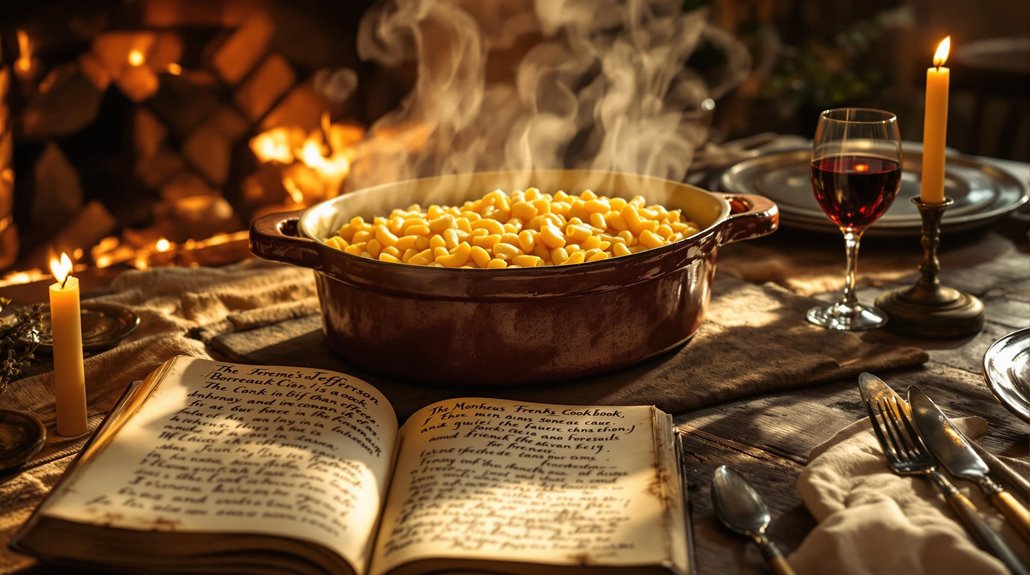
French culinary influence altered macaroni and cheese into a more refined dish before it reached American shores. You'll find that Thomas Jefferson played a pivotal role in its American expedition when he imported pasta and Parmesan cheese from Europe to Monticello. His enslaved chef, James Hemings, who trained in French cuisine, perfected the recipe and passed this knowledge to his brother Peter.
While you might think Jefferson invented this comfort food, he simply helped popularize it in colonial America. The dish was already appearing at New England church suppers when Mary Randolph published the first American recipe in her cookbook "The Virginia Housewife" in 1824. This blend of French refinement with American practicality transformed the simple cheese and pasta combination into a dish that would become an enduring American classic. Much like other homemade cheese products of the colonial era, macaroni and cheese became an essential part of the rural American diet.
James Hemings and Thomas Jefferson's Legacy
Behind Jefferson's celebrated introduction of macaroni and cheese to America lies the oft-overlooked story of James Hemings, an enslaved chef whose culinary prowess shaped American dining.
As Thomas Jefferson's enslaved chef, Hemings spent five years in Paris honing French cuisine. His training would transform the way America ate, particularly through his preparation of macaroni and cheese at Monticello. While the dish's recipe was later documented in Mary Randolph's "The Virginia Housewife," Hemings deserves credit for its initial American adaptation. Though Jefferson owned over 600 slaves, he freed only two in his lifetime - Hemings being one of them, acknowledging his exceptional culinary contributions. The story of macaroni and cheese in America reflects the complex intersection of slavery, innovation, and the evolution of American cuisine.
The Rise of Modern Mac and Cheese
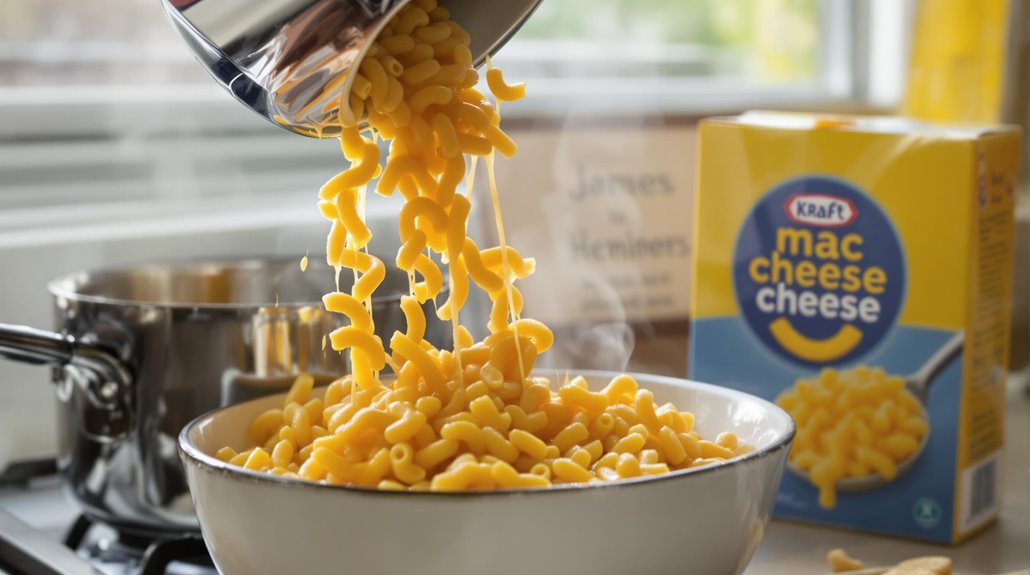
During America's Great Depression, a revolutionary product emerged that would forever change how families enjoyed macaroni and cheese. Kraft Dinner became an instant success when it hit shelves in 1937, selling an impressive 8 million boxes in its first year. You'll find this classic Mac N Cheese has evolved through generations, as home cooks created their own variations of the cheese sauce.
Here's how Kraft macaroni and cheese became a cultural phenomenon:
- It provided an affordable meal solution during tough economic times
- The convenience of boxed preparation saved time and effort
- Its versatility allowed for creative recipes using Cheddar cheese and grated Parmesan
- Home cooks adapted it using techniques like Butter rolled in Flour
While boxed varieties gained popularity, traditional Macaroni and cheese recipes remained cherished family traditions.