Does Government Cheese Still Exist in the United States?
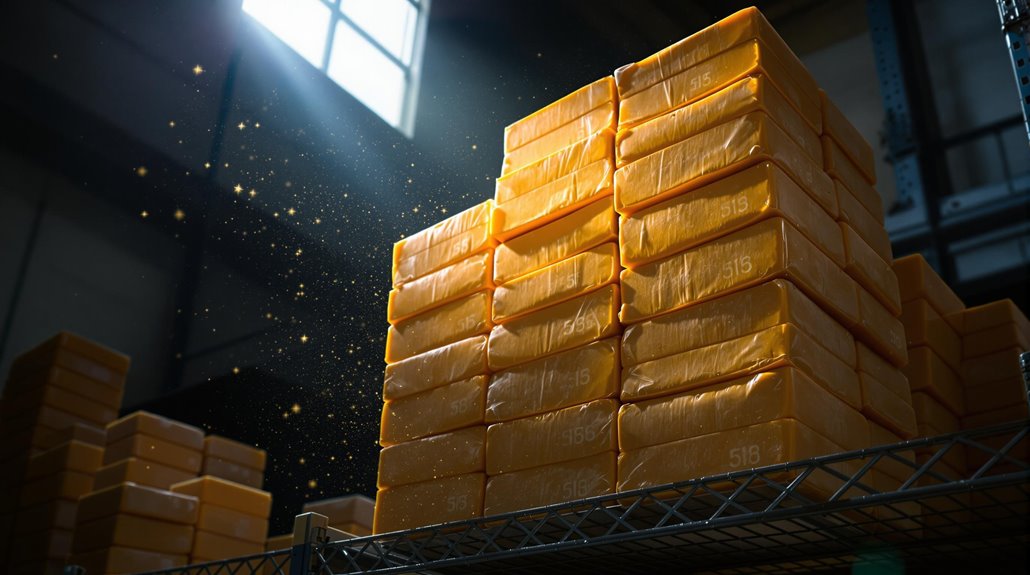
Government cheese no longer exists in its original form in America today. While you can't get those signature yellow blocks through federal assistance programs anymore, the program's legacy lives on in American culture. The practice ended in the 1990s when dairy surpluses decreased and the USDA shifted away from storing billions of pounds in Missouri caves. The story behind this unique chapter in American food policy reveals fascinating perspectives about poverty, politics, and social welfare.
The Birth of Government Cheese in America
The Great Depression marked the beginning of America's unique relationship with government cheese. When dairy farmers struggled to stay afloat during the 1930s, the Government stepped in with a bold solution: they'd buy and store surplus dairy products to stabilize milk prices and support the industry. This initiative mirrored how ancient civilizations had long recognized cheese as a valuable food source. What started as a modest Food assistance program evolved into something much bigger by the 1970s and 80s.
You might be surprised to learn that the American Government Cheese Program reached its peak with over a billion pounds of cheese stored in Missouri caves. In 1981, President Reagan expanded the program's reach by allowing the distribution of this surplus to low-income families. While this helped many Americans access dairy products, it also sparked debates about the program's impact on both recipients and the private cheese market.
How Reagan's Era Changed Dairy Distribution
During President Reagan's administration, America's relationship with government cheese underwent a dramatic transition. When he signed legislation creating the Temporary Emergency Food Assistance Program, government cheese became widely distributed to low-income Americans. You'll find it interesting that this initiative helped address two major issues: supporting dairy farmers through price stabilization and providing food assistance to those in need.
The States Department of Agriculture had accumulated billions of pounds of cheese stockpiled through its support programs for storable dairy products. President Ronald Reagan's solution converted this surplus into Emergency Food Assistance Program distributions. While this approach helped reduce storage costs and feed hungry Americans, it also created lasting stigmas around government assistance.
These programs gradually diminished by the 1990s as dairy markets stabilized and the need for extensive government cheese stockpiles decreased. Much like James L. Kraft's success with processed cheese in 1916, the government cheese program demonstrated how dairy innovation could address nationwide distribution challenges.
Inside the Missouri Cheese Caves
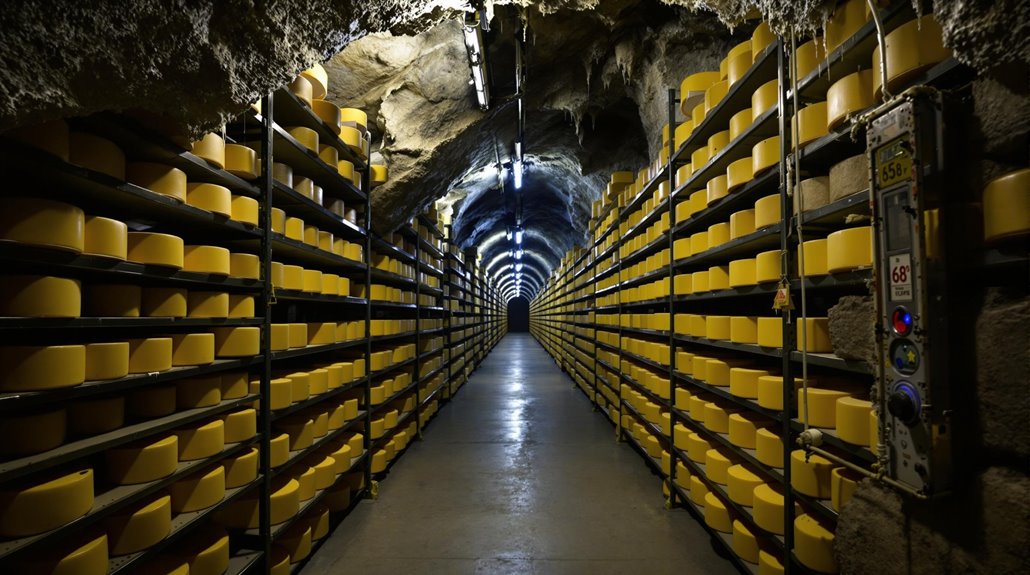
Deep beneath Missouri's rugged terrain, massive caves near Carthage played an indispensable role in America's government cheese program. These natural underground storage facilities became the solution to managing the dairy industry's massive food surpluses, housing an astounding 1.4 billion pounds of surplus cheese at its peak.
The caves' natural advantages made them perfect for storing the cheese stockpile:
- Consistent temperature control that preserved the cheese quality
- Vast storage space to accommodate the growing dairy market surplus
- Protection from external elements that could compromise the inventory
- Cost-effective storage solution for price support programs
You might be surprised to learn that this underground cheese empire wasn't just about storage - it represented the government's response to supporting dairy producers while managing excess dairy consumption through food assistance programs.
This massive cheese storage operation emerged during a transformative period when American cheese production shifted from small-scale farming to industrial-scale manufacturing in the 1800s.
From Public Aid to Cultural Symbol
Beyond its practical role in feeding millions of Americans, government cheese emerged as a powerful cultural symbol that represented both the promise and challenges of federal assistance programs. You'll find that this surplus cheese became more than just a food product - it transfigured into a complex emblem of poverty and federal aid in American society. For many low-income Americans who received this assistance, government cheese carried a social stigma that they'd remember for years to come.
The program's impact on agricultural markets and food assistance policies continues to spark discussions today, even though the massive cheese stockpiles have long since dwindled. While you won't find government cheese in distribution anymore, its legacy as a cultural symbol persists, reminding us of an era when federal aid took the form of processed cheese blocks.
The End of Federal Cheese Programs
As dairy surpluses decreased throughout the 1990s, the era of government cheese distribution began its steady decline. The federal government's practice of buying excess dairy products, which had originated during World War II, was no longer necessary as markets stabilized. You'll find that the once-abundant pasteurized process American cheese, distributed through food banks and community centers, became increasingly scarce by the early 2000s.
Several factors contributed to the program's end:
- The government would buy fewer dairy products as surpluses diminished
- Farm bill changes reduced the need for price support programs
- School lunch program needs were met through other sources
- Billions of pounds of stored cheese were finally depleted
The USDA officially moved away from using cheese stockpiles for food assistance, marking the end of this unique chapter in American food policy.
Modern Dairy Surpluses and Storage
While government cheese distribution has ended, modern dairy surpluses remain a significant issue in the United States. You'll find over 1.4 billion pounds of cheese stored in private facilities across the country, but unlike the past, it's not government-owned. This massive cheese surplus stems from ongoing dairy overproduction, declining milk consumption, and trade disputes.
The dairy industry continues to receive substantial government support, with over $79 billion provided in 2016-2017 alone. As Americans drink less milk - consumption dropped from 275 pounds per person in 1975 to 149 pounds in 2017 - cheese stockpiling has increased dramatically. To address these surpluses, organizations like Dairy Management Inc. have launched cheese campaigns to enhance consumption, though the challenge of balancing production with demand persists.
Legacy and Lessons for Food Policy
The government cheese program's enduring legacy offers critical viewpoints into modern food policy challenges. When you examine its impact, you'll find precious lessons about agricultural policy and surplus management that still apply today.
- Price supports for the dairy industry created unintended consequences, leading to massive stockpiles that required creative distribution solutions
- Food assistance programs have evolved from direct commodity distribution to more flexible approaches that better serve communities
- The cultural stigma of reliance on federal aid through government cheese has influenced how we think about food security programs
- Modern food policy continues to wrestle with balancing producer support and effective assistance delivery
These lessons shape current discussions about societal impact and the role of government intervention in agricultural markets. They're particularly relevant as policymakers work to create more sustainable and equitable food systems.